
Armed security guards in California must complete two separate licensing requirements before carrying a firearm on the job.
First, they need a valid Guard Card issued by the California Bureau of Security and Investigative Services (BSIS).
Second, they must earn an Exposed Firearms Permit, which requires additional training, a range qualification, and a separate background check. Neither can be skipped or combined.
Disclaimer: This article reflects California BSIS licensing requirements as understood at the time of publication. Requirements are subject to change. Verify current training hour requirements and permit conditions directly with the California Bureau of Security and Investigative Services at bsis.ca.gov before making staffing decisions.
Step 1: The Guard Card
Every security officer in California starts with a Guard Card, whether armed or unarmed. This is the baseline license issued by BSIS under the California Business and Professions Code.
To get a Guard Card, an applicant must complete 8 hours of pre-assignment training before they can begin work. This covers Powers to Arrest, which defines what a security officer can and cannot legally do on the job.
After being hired, the officer has 6 months to complete 32 additional hours of BSIS-approved coursework, bringing the total to 40 hours.
Those 32 hours include modules on:
- Terrorism awareness and emergency response
- First aid and CPR
- Fire and life safety
- Ethics and professional conduct
- Communication and report writing
The Guard Card must be renewed every two years. Officers who let it lapse cannot legally work, armed or unarmed, until it is reinstated.
Step 2: The Exposed Firearms Permit
A Guard Card alone does not authorize a security officer to carry a firearm. That requires a separate Exposed Firearms Permit (EFP), also issued by BSIS.
To qualify, the officer must already hold a valid Guard Card, then complete a BSIS-approved firearms training course. The training covers:
- Legal authority and limits on use of force
- Firearm safety rules and handling
- Threat assessment and decision-making
- Range instruction and live-fire qualification
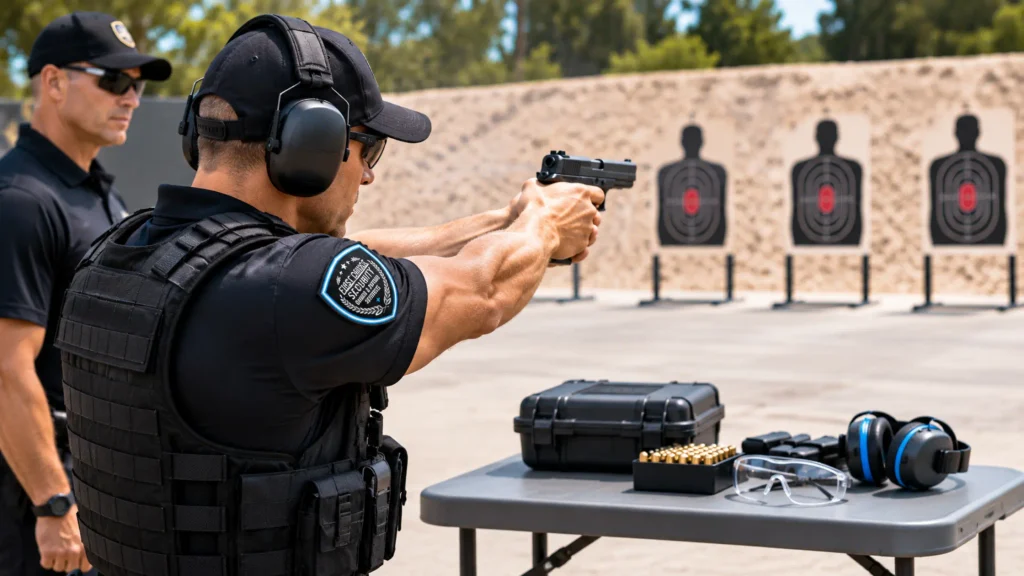
The officer must pass both a written examination and a live-fire range qualification to receive the permit. The permit also specifies which firearm types the officer is qualified to carry. An officer qualified on a handgun is not automatically permitted to carry a shotgun.
NOTE: Verify the exact hour requirements for EFP training against the current BSIS website before publishing. Requirements are subject to regulatory update.
Annual Requalification
Armed security in California is not a one-time credential. Officers holding an Exposed Firearms Permit must complete annual firearms requalification to keep the permit active.
Requalification includes classroom review of use-of-force law and updated legal standards, plus a live-fire range session. Officers who miss their requalification window cannot carry a firearm until they complete it. This is not optional and cannot be deferred.
The annual requirement is part of why armed security costs more than unarmed coverage. The ongoing training, qualification, and licensing overhead is real and reflected in the rate.
Who Can Qualify
Not everyone who applies for an Exposed Firearms Permit will receive one. BSIS runs a background check as part of the process. Disqualifying factors include:
- Felony convictions
- Certain misdemeanor convictions, including weapons-related charges
- Active restraining orders
- History of mental health adjudications that affect firearms eligibility
- Being prohibited from possessing a firearm under California or federal law
Applicants must also be 18 or older, legally authorized to work in the United States, and able to pass the written and range components of the training course.
What Armed Guards Can and Cannot Do
Having an Exposed Firearms Permit does not give a security officer the same authority as a peace officer. Armed guards are private employees, not law enforcement. Their authority is defined by California law and the scope of their assignment, not by the firearm they carry.
They can use force, including deadly force, only under the same legal standards that apply to any private person in California.
The firearm is a defensive tool, not a tool of authority. Our article on what security guards can legally do in California covers these limits in detail.
Where Armed Guards Are Typically Deployed
Armed security is not the right fit for every property. It makes sense where the risk profile justifies the cost and where the presence of a firearm does not create liability or discomfort that outweighs the protection it provides.
Common deployments include:
- Financial institutions and cash-handling operations
- Jewelry stores and high-value retail
- Pharmaceutical and controlled substance storage
- Executive protection assignments
- Late-night commercial properties with high theft or robbery history
- Some California industries that are required by law to have licensed security on site specify armed coverage
For properties that are unsure whether armed or unarmed coverage is the right call, our guide on armed vs unarmed security walks through the decision factors.
Frequently Asked Questions
Do security guards in California need a license to carry a firearm?
Yes. A Guard Card alone is not enough. Officers must hold a separate Exposed Firearms Permit issued by BSIS, which requires additional training, a written exam, and a live-fire range qualification. Carrying a firearm without the permit is a violation of California law.
Can an armed security guard carry any type of firearm?
No. The Exposed Firearms Permit specifies which firearm types the officer is qualified to carry. A handgun qualification does not cover a shotgun or rifle. Each firearm type requires its own training and qualification under BSIS rules.
How long does it take to become a licensed armed security guard in California?
The timeline depends on course scheduling and BSIS processing times. Getting the Guard Card first, then completing the firearms training and permit application, typically takes several weeks to a few months. Officers cannot carry a firearm until the permit is issued.
Do armed guards have to requalify every year?
Yes. Annual firearms requalification is required to keep the Exposed Firearms Permit active. It includes both classroom instruction on current use-of-force law and a live-fire range component. Missing the window means the officer cannot legally carry until requalification is completed.
Is an armed security guard the same as a police officer?
No. Armed security officers are private employees whose authority comes from California property law and their employer’s scope of work, not from law enforcement powers. They carry a firearm for defensive purposes, not to enforce public law.
How much does armed security cost compared to unarmed?
Armed coverage costs more because of the additional licensing, annual requalification, and liability involved. Our breakdown of the cost of armed security explains what drives the rate difference and what clients typically pay in California.
Can a security guard with a Guard Card work while waiting for the Firearms Permit?
Yes, but only in an unarmed capacity. The Guard Card authorizes unarmed security work. The officer cannot carry a firearm in any work capacity until the Exposed Firearms Permit is issued.
Does California recognize armed security licenses from other states?
No. California does not recognize out-of-state security licenses. An officer licensed in another state must complete the California Guard Card process and separately qualify for a California Exposed Firearms Permit before working in the state.
What happens if an armed guard’s permit expires?
An officer with an expired Exposed Firearms Permit cannot legally carry a firearm on duty until the permit is reinstated. This typically requires completing requalification and submitting a renewal application to BSIS. Employers are responsible for tracking permit status for every armed officer on their roster.
Does First Choice Security employ armed guards in California?
Yes. Our armed officers hold valid California Guard Cards and Exposed Firearms Permits issued through BSIS. All officers are W-2 employees, not contractors, and their licensing and annual requalification status is tracked by our management team. Contact us at 855-625-7233 to discuss whether armed coverage is the right fit for your property.