

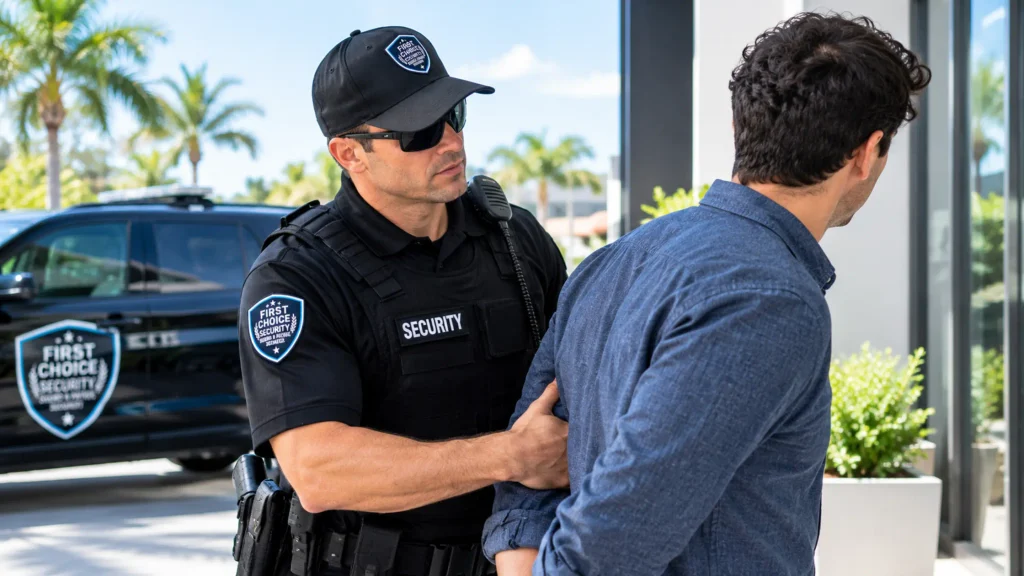
A Florida security guard can touch you in limited situations. These include a lawful shopkeeper’s detention, a common-law arrest for a felony they witnessed, self-defense, or physically removing a trespasser.
Outside those situations, touching you without consent is not permitted.
Disclaimer: This article is for general information only and does not constitute legal advice. Florida law is subject to change. If you have questions about a specific situation, consult a licensed Florida attorney.
Who Regulates Security Guards in Florida
Florida security guards are licensed by the Florida Department of Agriculture and Consumer Services (FDACS)under Florida Chapter 493.
There are two license types. Class “D” officers are unarmed guards who complete 40 hours of training before working independently. Class “G” officers are armed security guards who must first hold a Class “D” license and then complete 28 hours of additional firearms training plus annual requalification.
Both types are trained on exactly when physical contact with the public is and is not allowed. Our Florida security guard services operate under these same licensing requirements.
When a Florida Security Guard Can Lawfully Touch You
Shopkeeper’s Privilege Under Florida Statute 812.015
This is the most common legal basis for a guard to detain someone in Florida. It is also stricter than most people expect.
Under Florida Statute 812.015, a merchant or their employee can briefly detain someone if they have probable cause to believe that person committed retail theft. Probable cause is a higher bar than California’s “reasonable cause” standard. The detention must be brief and handled reasonably.
Florida also requires that law enforcement be called immediately after the person is taken into custody. A guard cannot hold someone indefinitely.
One specific detail:
if a properly posted anti-shoplifting tag activates at the exit, that alone can justify a brief stop. The store must have visible notice that the devices are in use. Florida’s statute also covers trespass and applies beyond typical retail to farmers and transit agencies.
Common-Law Arrest for a Felony
Florida has no citizen’s arrest statute like California’s Penal Code 837. The authority comes from common law.
A private person in Florida can make an arrest if a felony occurred and they have reasonable grounds to believe the person committed it. The risk is personal liability.
If the officer is wrong and no felony occurred, they can face a false imprisonment claim.
Most agencies train guards to rely on the shopkeeper’s statute instead.
Self-Defense and Defense of Others
A guard can use reasonable physical force to defend themselves or another person from an immediate threat. This comes from Florida Chapter 776.
Florida’s stand-your-ground law is part of Chapter 776. It means a guard has no duty to retreat when lawfully present. But force must still match the actual threat. It is not a blank check.
Removing a Trespasser
A security guard acting on behalf of a property owner can physically remove someone after a lawful trespass warning under Florida Chapter 810. If the person refuses to leave or becomes physical, the guard can use reasonable force to complete the removal.
When a Florida Security Guard Cannot Touch You
Security guards are not police officers. There are clear situations where they have no right to make physical contact.
A Florida security guard cannot:
- Detain you based on suspicion alone. Probable cause is required under FS 812.015, not just a gut feeling.
- Force you to open your bag. Guards have no search authority. You can refuse.
- Use force after you comply. If you are cooperating and the situation is over, continued physical contact is not permitted.
- Hold you just because you will not show ID. Florida law does not require you to identify yourself to a private security officer.
- Keep you detained beyond what is reasonably necessary. Once law enforcement is called and the situation is documented, the detention should end.
Florida vs. California: How the Laws Compare
| Florida | California | |
| Shopkeeper’s statute | FS 812.015 | Penal Code 490.5 |
| Detention standard | Probable cause | Reasonable cause |
| Call law enforcement | Required immediately | Not required |
| Covers trespass | Yes | No |
| Citizen’s arrest statute | No (common law only) | Yes (Penal Code 837) |
| Anti-shoplifting tag | Can justify detention | Not addressed |
| Regulatory body | FDACS | California BSIS |
| Unarmed license | Class “D” | Guard Card |
| Armed license | Class “G” | Guard Card + Exposed Firearms Permit |
Florida’s probable cause standard is the biggest practical difference. A guard who detains someone without reaching that bar loses the legal protection FS 812.015 provides.
For the full California breakdown, see our article on can security guards touch you in California.
How the Law Applies in Common Florida Settings
Theme parks and attractions are private property. Security can issue trespass warnings and remove guests who break park rules. Visible security presence is one of the strongest deterrents at high-traffic venues like these. These officers have no authority beyond what Florida common law and FS 812.015 allow.
At the Mall at Millenia and similar retail properties, guards work under the shopkeeper’s privilege framework. Read our guide on mall security for shoppers and retailers for how these deployments work in practice. Probable cause still applies. The guard is an agent of the merchant, not a police officer.
Hotel and resort security can remove a non-guest after a lawful trespass warning. Guests who break hotel rules or local law can also be removed. Most hotel incidents involve removal from property, not theft detention.
Guards working HOA communities can enforce access control and remove unauthorized persons who refuse to leave. Their authority is tied to the property owner’s rights.
At events and venues, security can remove attendees from private event space if needed. See our article on the role of security guards in event safety for what Florida Chapter 493 requires of those officers.
What to Do If a Guard Touches You Without Legal Basis
- Stay calm. Physically resisting a guard, even an unlawful one, creates additional legal problems. Comply in the moment and challenge it through the right channels afterward.
- Write down everything as soon as possible. Note the time, location, what was said, what happened, and any witnesses. Note where cameras were.
- Ask for the officer’s name and employer. Licensed Florida guards are required to carry their FDACS identification card.
- Call law enforcement if a crime occurred. If the guard committed assault or false imprisonment, file a police report.
- File a complaint with FDACS. The Division of Licensing accepts complaints against licensed guards and agencies. A verified violation can lead to license suspension.
- Talk to an attorney. If you were injured or held without legal basis, a Florida attorney can advise you on a civil claim.
Frequently Asked Questions
Can a security guard detain you in Florida?
Yes, under limited circumstances. Florida Statute 812.015 gives security officers the right to briefly detain someone if they have probable cause to believe that person committed retail theft. Outside that, a guard may only make a common-law arrest if they personally witnessed a felony.
Can a security guard search your bag in Florida?
No. Security guards in Florida have no authority to search your belongings without consent. You can refuse. A forced search without consent may void the officer’s legal protection under the shopkeeper’s statute.
Can a security guard handcuff you in Florida?
A guard can use restraints during a lawful detention if you are actively resisting or pose a threat. Handcuffing someone who is cooperating and not threatening harm is not permitted and can expose the officer to a false imprisonment claim.
Can a security guard trespass you from a Florida property?
Yes. Under Florida Chapter 810, property owners and their agents can issue trespass warnings and remove people from private property. Returning after a lawful warning can result in a criminal trespass charge.
What happens if a guard detains someone without probable cause?
They lose the immunity that FS 812.015 provides. The detained person may have a civil claim for false imprisonment. The officer may also face a complaint with FDACS that puts their license at risk.
Do Florida security guards have to identify themselves?
Licensed guards are required to carry their FDACS identification card. They are expected to identify themselves and their employer when asked.
Can an armed guard use their firearm to detain someone?
Armed Class “G” officers carry firearms for defensive purposes. Using a firearm during a detention goes beyond what FS 812.015 permits in most situations. If you are weighing whether armed coverage is right for your property, our guide on armed vs unarmed security covers the key factors.
Is the law different at Florida theme parks?
The underlying law is the same. Theme parks are private property, so their security can issue trespass warnings and remove guests. For theft-related detentions inside park stores, the shopkeeper’s statute still applies and probable cause is still required.