
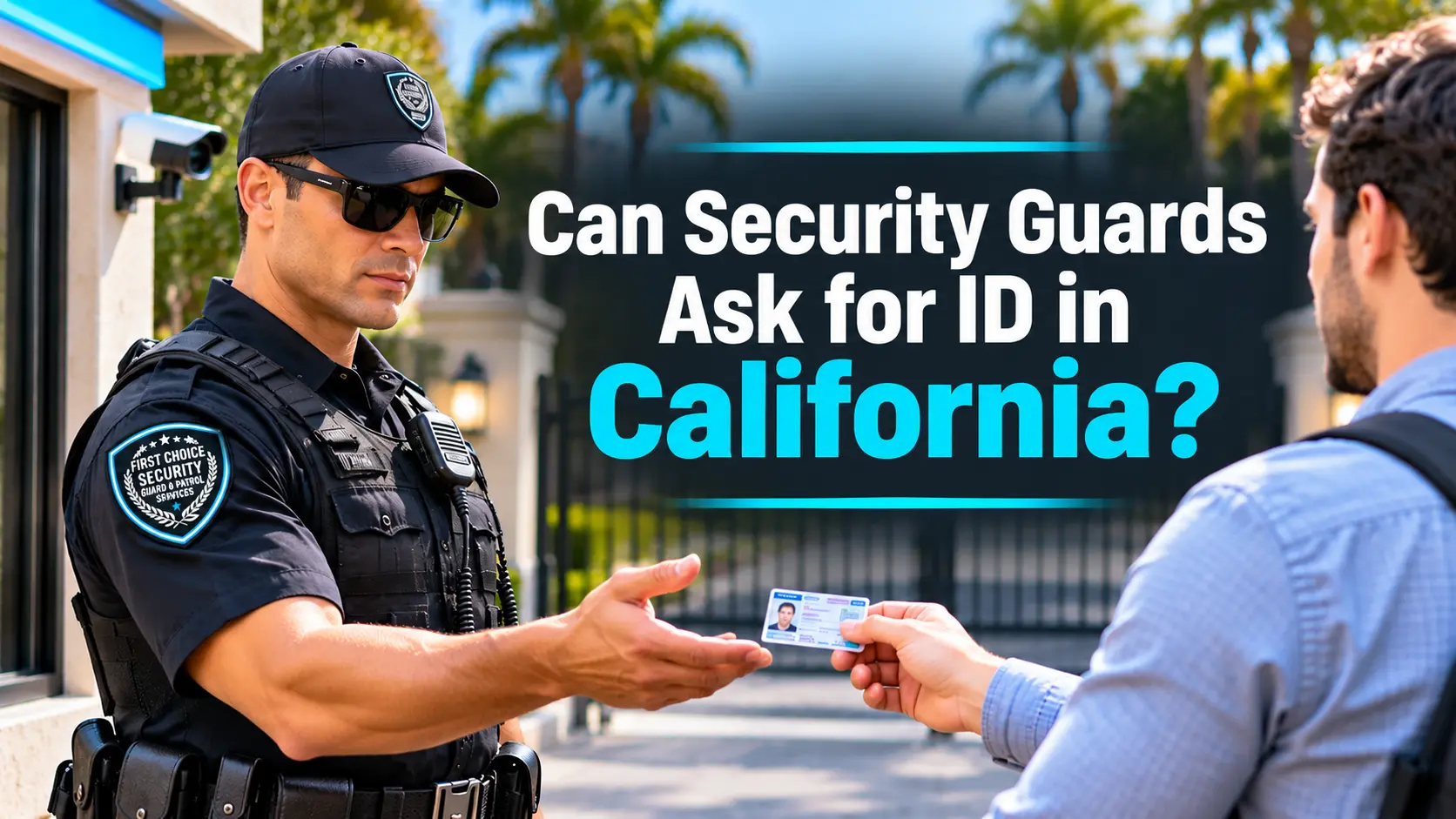
Yes, a security guard in California can ask you for ID. In most situations, you are not legally required to show it. Those are two different questions, and the answer depends on where you are and what authority the guard actually has.
Disclaimer: This article is for general information only and does not constitute legal advice. California law is subject to change. Consult a licensed California attorney for questions about a specific situation.
Asking Is Not the Same as Demanding
A security guard can always ask for your ID. What they cannot do is legally compel you to produce it.
California’s stop-and-identify laws apply only to peace officers, not to private security. Under Business and Professions Code §7582.1, a licensed security officer’s authority is limited to the property they protect and the instructions of their employer. That authority does not include forcing identification from someone who declines.
If you refuse, the guard can deny you access or ask you to leave. They generally cannot detain you solely because you would not show ID.
When a Security Guard Can Ask for ID
Access Control on Private Property
A corporate campus, gated community, or secured building can require ID as a condition of entry. The property owner sets that rule. The guard enforces it. Refusing means you can be denied entry. That is not a legal violation. It is the property owner’s right.
Visitor Credentialing
Contractors, vendors, and guests at office buildings are often required to show ID and sign in before entering. This is a standard access control protocol, not a legal demand.
Age Verification
At bars, nightclubs, and dispensaries, age verification is a legal requirement under California law, not a discretionary request. Refusing to show ID means you will not be served or admitted.
Active Incident Documentation
Under California Penal Code §837, a private person can make an arrest for a felony committed in their presence. During such a detention, the guard may request identifying information to document the incident before law enforcement arrives.
When You Are Not Required to Show ID
California has no general stop-and-identify statute covering private security. Outside the situations above, you are not required to comply.
- On public property: you can decline. The guard has no authority to detain you for that refusal.
- On private property with no stated ID requirement: the guard can ask, but they cannot compel.
What Happens After You Refuse
- On private property: you can be denied entry or asked to leave. If you refuse to leave, the property owner can issue a trespass warning under Penal Code §602. Returning after that warning can result in a criminal trespass charge.
- During a shopkeeper’s detention (Penal Code §490.5): the guard notes your refusal in the incident report. It does not end the detention. It becomes part of the documentation passed to law enforcement.
In either case, a guard cannot physically force you to produce ID, search your belongings to find it, or extend a detention solely because you declined.
Guards Cannot Ask Selectively
A security guard cannot apply ID requests selectively based on race, ethnicity, national origin, religion, gender, or other protected characteristics.
Discriminatory enforcement exposes the property owner and the security company to civil liability under California’s Unruh Civil Rights Act. Asking some visitors for ID but not others based on how they look is not a defensible security practice.
Security Guard vs. Police Officer: ID Authority in California
| Security Guard | Police Officer | |
| Can ask for ID | Yes | Yes |
| Can legally compel ID | No | Yes, under specific conditions |
| Authority source | Property owner / employer | California Penal Code |
| Detention authority | Penal Code §837 (limited) | Full peace officer powers |
| Consequence of refusal | Denial of access or removal | Possible lawful detention |
| Jurisdiction | Assigned property only | Statewide |
For a full breakdown of what security guards can legally do in California, see our article on whether security guards can make an arrest in California.
How This Plays Out in Common California Settings
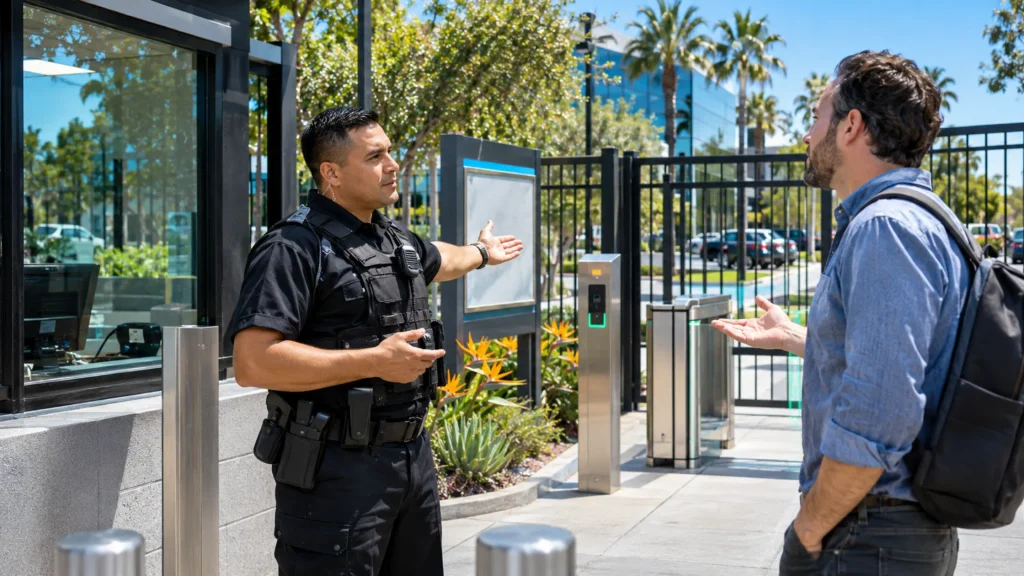
HOA gated community: The HOA sets the access rules. Guards enforce them. Guests who refuse ID can be denied entry.
- Corporate campus: Visitors are typically required to sign in and show ID as a condition of entry. Refusing means you do not get in.
- Retail store: Guards have no authority to demand ID from a shopper simply for being present. During a lawful shopkeeper’s detention under Penal Code §490.5, they may request identifying information but cannot compel it. See our article on what security guards can and cannot do in California for how that plays out.
- Bar or nightclub: Age verification is a legal obligation, not a request. Refusing to show ID means you do not enter.
- Apartment complex: Guards can require visitor ID at a controlled entry point if that policy exists. They cannot compel a resident to show ID inside the building.
- Public sidewalk or transit: A private security officer in a public space has no ID authority. Their authority is defined by their contract and California law, not by their uniform.
Frequently Asked Questions
Can a security guard legally ask for my ID in California?
Yes. Asking is always permitted. Whether you are required to provide it depends on the setting.
Do I have to show my ID to a security guard?
In most situations, no. California’s stop-and-identify laws apply to peace officers, not private security. On private property where ID is a stated condition of access, refusal means denial of entry. At age-restricted venues, refusal means you will not be served.
Can a security guard detain me for refusing to show ID?
No. Refusing to show ID is not by itself a basis for detention. A guard can detain someone only under Penal Code §837 for a witnessed felony or under Penal Code §490.5 for suspected retail theft.
What can a security guard do if I refuse to show ID on private property?
They can deny access, ask you to leave, and issue a trespass warning under Penal Code §602 if you refuse to leave.
Is refusing to show ID to a security guard illegal in California?
No. The consequences are civil and practical: denial of access or removal from property, not criminal charges.
Can a security guard ask for ID at an HOA gate?
Yes. Gate access control is one of the clearest cases where an ID request is legitimate. Guests who refuse can be denied entry.
Is age verification treated differently?
Yes. At bars, nightclubs, and cannabis dispensaries, ID verification is a legal requirement. That is not the guard exceeding their authority. It is California law.
Can a security guard write down my ID information without my consent?
If you voluntarily show your ID as part of a check-in process, the property can record it. During a lawful detention under Penal Code §490.5 or §837, the guard may document identifying information. Outside those situations, recording personal information without consent raises privacy concerns.
How is this different from a police officer asking for ID?
A police officer conducting a lawful stop has statutory authority to request identification. A private security guard does not. The guard’s power to ask comes from the property owner’s rules, not from any police power. See our article on whether security guards can touch you in California for more on how guard authority compares to law enforcement.
Do First Choice Security guards ask for ID?
Our guards ask for ID when their post orders require it, typically at gated community entry points, corporate visitor check-ins, and event access management. All officers are W-2 employees trained on the limits of their authority under California law. Call 855-625-7233 to discuss access control protocols for your property.